

Types of Contracts: A Practical Guide to Choosing the Right Form
By Anirudh Menon, Viaclause editor
Compare contract types by purpose, formation, promises, pricing and performance. Use a worked services deal, classification matrix and selection checklist.
Types of contracts can describe different things: the deal's purpose, how agreement is expressed, how promises are exchanged, how payment is calculated, what performance remains and whether the arrangement is enforceable. These classifications overlap. A written services agreement can be express, bilateral, fixed-price and still awaiting performance at the same time.
First check the elements of a contract. A useful classification helps you select documents and manage obligations; the label alone does not establish formation or enforceability.
Classify the contract by the question you need to answer
| Dimension | Common labels | Practical question |
|---|---|---|
| Business purpose | Services, sale, NDA, license, lease, employment or partnership. | Which relationship, rights and obligations must the documents address? |
| Expression of agreement | Express: terms stated in words. Implied in fact: agreement evidenced by conduct. | Are the terms shown by words, conduct or the surrounding record? |
| Exchange structure | Bilateral: reciprocal promises. Unilateral: requested performance accepts an offer. | Does the offer seek a return promise or specified performance? |
| Form and evidence | Written; oral; electronic records. | What proves the terms, and does a specific writing or execution rule apply? |
| Pricing | Fixed-price; hourly or time-and-materials; cost reimbursement; incentive arrangements. | What triggers payment and who bears particular cost risks? |
| Performance status | Executory; fully performed, with “executed” needing context. | What remains to be done at the date you are checking? |
| Legal effect | Valid, void, voidable or unenforceable, depending on the defect and law. | Can this agreement or provision be enforced, challenged or avoided? |
The agreement and exchange distinctions are illustrated in California CACI 305 and the South Carolina court's Southern Glass opinion. Legal effect requires the separate review explained below.
Do not force these labels into a single mutually exclusive list. “NDA or bilateral?” compares a document's purpose with its promise structure. “Fixed-price or written?” compares pricing with form. Neither pair requires choosing just one.
Before classifying an arrangement, the contract versus agreement comparison helps distinguish the evidence of an agreement from a conclusion about enforceability.
To trace agreement in the first place, the offer and acceptance event worksheet follows an unchanged assent, a conditional price reply and an unanswered proposal, with goods analysed separately.
Express, implied in fact and quasi-contract are different inquiries
An express agreement uses spoken or written terms; an implied-in-fact agreement is shown through conduct. California's CACI 305 requires intentional conduct and awareness that the other party will interpret it as agreement. Express does not mean signed. CACI 305 and its authorities.
Suppose a business repeatedly requests the same approved service, receives it and pays invoices at the previously agreed rate. Record the requests, prior terms, deliveries, objections and payments before suggesting agreement by conduct. A supplier's decision to send an invoice does not supply the missing agreement. The implied contract evidence checklist helps organize that record.
Implied in law, often called quasi-contract, is not another way of proving consent. In Hercules v. United States, the Supreme Court distinguished a tacit agreement inferred from conduct from a legal obligation imputed without actual agreement. The distinction mattered because Tucker Act contract jurisdiction covered express and implied-in-fact contracts, not implied-in-law claims. That jurisdictional holding concerns claims against the United States. Hercules, pages 423 to 424.
Keep two questions separate: “What price did we agree?” and “Is there a restitution basis for recovering the value of a benefit?” Receiving a benefit does not automatically establish the sender's requested price or a right to restitution. Preserve evidence of value transfers and the applicable legal basis.
Bilateral and unilateral describe what accepts the offer
In a bilateral exchange, each side makes a promise: a consultant promises defined work and the buyer promises payment. A unilateral offer instead calls for the specified performance, such as returning an identified lost item for a stated reward. South Carolina's Court of Appeals drew this distinction in Southern Glass & Plastics v. Kemper. Southern Glass, No. 5021, opinion reproduced by FindLaw.
That court affirmed summary judgment in an insurer's dispute with an automobile-glass provider, finding acceptance of communicated pricing through performance. It distinguished differently worded offers requiring conforming invoices. The requested acceptance matters; performing work alone is not a complete analysis.
For a real offer, record its recipient, the precise act or promise requested, deadlines, notice requirements and what occurred. Review the unilateral contract worked examples for revocation and partial performance. Unequal workloads do not make a services deal unilateral.
A “one-way NDA” describes the direction of disclosure or confidentiality duties. Determine the formation structure from what the offer requests in return, rather than the number of disclosing parties.
Choose the document around the business purpose
- Services agreement: Define the work, responsibilities, acceptance, payment, use rights and remedies.
- Sales agreement: Identify what is being sold, delivery, price, title-related questions, inspection and remedies.
- NDA: Address protected information, permitted use, recipients, exclusions and duration. It does not by itself commission a paid project.
- License: Define the right to use identified intellectual property, its scope, restrictions, payment and end-of-term consequences.
- Lease: Address possession or use of identified property, term, payments, maintenance and return.
- Employment or contractor agreement: Review the actual working relationship and applicable rules. Distinguish full-time or part-time hours from fixed-term or ongoing duration. Record duties, pay, benefits, policies and termination; a label does not guarantee job security or transfer all tax and benefit responsibilities.
- Partnership or joint venture arrangement: Define the collaboration, contributions, governance, economics and exit, with the relevant entity and liability analysis.
- Bill of sale or transfer record: Record an identified completed asset sale, including the item, parties, price and date. Check title, liens and registration documents separately; a receipt may leave those questions unresolved.
- Loan agreement or promissory note: State principal, interest, repayment, default and any security documents, with the relevant lending and instrument review.
- Shareholder arrangement: Address ownership, voting, transfers and exit alongside the entity documents.
- Termination or settlement: Identify what ends, payments or returns, releases, continuing duties and authority to settle.
These are document-selection prompts rather than complete legal definitions or templates. One arrangement can combine several purposes: a services project may also need a software license and confidentiality terms. Regulated, property and employment transactions need additional specialist review.
For recurring services, an MSA can contain the common framework while an SOW identifies a particular project. The master service agreement example shows the framework; the statement of work template supplies project scope, acceptance and change control. Check which documents actually create the work commitment and how they interact.
Order documents and continuing services need their own choices
A purchase order can place an order under a supplier framework or participate in forming a new commitment. Check the accepted terms, quantities, specifications, delivery and conflicting supplier documents. It is not the “opposite” of a sales contract. For repeated orders, identify minimum commitments, release procedures and the document that authorizes each purchase.
A retainer may pay for access, reserved capacity, defined work or a combination. Maintenance and support arrangements need included services, response targets, escalation, renewal and excluded projects. State whether unused hours roll over and which additional work requires approval. A software arrangement may need a license, hosting terms, data terms and support provisions in the same package.
Procurement systems may use their own category map
UConn's published Contracts+ map separates general purchasing, services, software, hotels and events, cooperative purchasing with or without participation documents, personal services, special terms, construction design, construction services and real-property leases. It identifies a sourcing record as a non-contract record and instructs how to record revenue value. These are UConn's organizational categories, not universal contract-law definitions. UConn, Understanding Contract Types, updated October 22, 2025.
A buyer using another institution's agreement should check eligibility, underlying terms, purchasing authority and any participation document. Separate architectural design from physical construction when selecting the review route. For software, record term or perpetual licensing, hosted services and zero-cost arrangements. For hotels and events, identify room blocks, attendance assumptions, cancellation charges and minimum spending. The category routes review; it does not determine formation or waive approvals.
Written, oral, electronic and formal concern form and evidence
A writing makes the agreed package easier to preserve and administer. California CACI 304 recognizes written, oral and mixed agreements, subject to statutory exceptions. CACI 304.
A writing rule can restrict enforcement. Washington's goods-sale rule generally requires a sufficient signed record for a sale priced at $500 or more. It includes merchant-confirmation and other exceptions, including accepted goods or payment. This is a Washington goods rule, not a universal threshold for services or real estate. RCW 62A.2-201.
For transactions in or affecting interstate or foreign commerce, federal E-SIGN section 7001 generally prevents denying effect solely because a record or signature is electronic. It preserves other legal requirements and does not generally force parties to accept electronic methods; special consumer-disclosure conditions also apply. 15 U.S.C. 7001(a) to (c), official 2024 Code edition.
Keep the final version, attachments, assent record, authority evidence and a retrievable copy. “Formal contract” needs context: identify the actual execution requirement, such as signatures, witnessing, notarization or delivery. Do not treat every written document as satisfying every formality. A “simple contract” label likewise does not exempt a transaction from applicable rules.
Pricing labels describe a separate allocation of risk
| Pricing approach | Fit and drafting question | Tradeoff and control |
|---|---|---|
| Fixed price for defined scope | Useful when scope and acceptance can be defined. What work is included? Which changes or expenses alter the price? | The supplier needs an estimate and may bear overruns; the buyer needs change rules and progress visibility. Cost savings do not automatically reduce the agreed price. |
| Hourly or time-and-materials | Useful when effort can be measured but final workload is uncertain. Specify rates, authorized time, permitted materials and ceilings. | Totals depend on usage. Review records and consumption before exhausting the budget; a ceiling is not an entitlement to invoice that amount. |
| Cost reimbursement or cost-plus | Useful for defined reimbursable costs. Which categories qualify? Specify evidence, exclusions, audit, budget alerts, limits and separate fee calculation. | Uncertain costs require more administration. Distinguish a fixed fee from a percentage fee; not every expense is reimbursable. |
| Unit price | Useful for measurable outputs. Define unit rate, quality, quantity measurement, volume changes and verification. | The total depends on verified units, not a quoted headline rate alone. |
| Incentive arrangement | Which measured result changes the fee, and how is it verified? | An incentive provision does not replace the underlying scope or payment structure. |
For construction, compare pricing separately from delivery structure and project responsibilities. Fixed price needs clear scope, assumptions, allowances, schedule and changes. Cost-plus can accommodate defined reimbursable work but requires more invoice and cost review. Neither structure guarantees savings or transfers every project risk.
A guaranteed maximum price needs its own wording: what scope, allowances, contingency, exclusions, changes and fee are inside the maximum? A budget estimate, invoice ceiling and GMP are not interchangeable. In an original fictional comparison, $40,000 of eligible costs plus a fixed $4,000 fee totals $44,000. Costs of $43,000 plus the same fee total $47,000. If the agreed all-inclusive maximum is $45,000, apply the cap and change rules rather than automatically invoice $47,000. This illustration assumes no approved cap increase.
Federal procurement has defined categories and restrictions. FAR 16.101 organizes types around cost responsibility and profit incentives. FAR 16.202-1 describes firm-fixed-price by the absence of cost-experience price adjustments; FAR 16.301-1 addresses allowable incurred costs and a cost ceiling. Those government rules are not automatically the terms of a private consulting deal. FAR 16.101; FAR 16.202-1; FAR 16.301-1.
FAR 16.601 separately describes time-and-materials, including fixed hourly rates and material costs, and imposes use, oversight and ceiling requirements. Federal buyers should check the solicitation, applicable clauses and agency rules. Private parties should state their own rates, permitted costs, approval process and limits. FAR 16.601.
Worked business classification matrix: one deal, several labels
All details are fictional. Riverworks buys two process maps from Maple Advisory. Both parties sign an MSA and SOW1 on October 9, 2026. SOW1 specifies the outputs and acceptance process, with a fixed $7,200 project price. It authorizes no workshop. Both sides assume capable, authorized parties, real consent, lawful work and sufficient consideration; the example is not a legal finding.
| Dimension | SOW1 on October 9 | CO1 signed October 20 |
|---|---|---|
| Purpose | Professional services: two maps. | Additional services: workshop. |
| Evidence and form | Express terms in signed MSA R1 and SOW1. | Express signed change terms linked to the package. |
| Exchange | Bilateral promises: work for payment. | Bilateral promises: authorized workshop for payment. |
| Price | Fixed $7,200 for the original scope. | $150 per authorized hour, maximum eight hours. |
| Status when signed | Delivery, review and payment remain. | Workshop and payment remain. |
| Legal effect | Assumptions stated, not certified by classification. | Authority and governing terms need review. |
COMPLETED CLASSIFICATION CARD, FICTIONAL
Package: MSA R1 + SOW1
Purpose: professional services
Agreement evidence: express terms in signed writing
Exchange: bilateral promises, work for payment
Project price: fixed 7200 USD for two defined maps
Status on October 9: signed; performance remains
Delivery: October 26
Acceptance: October 28, if agreed tests are met
Payment: separate trigger and deadline in SOW1
Confidentiality and other continuing duties: track separately
Workshop: not authorized by this package
Legal effect: requires review; categories do not establish validity
The deal is express, written, bilateral and fixed-price. It is also awaiting performance. None of those labels excludes the others. Its governing framework and project schedule form the package; calling it an MSA does not explain the particular project's price or deliverables.
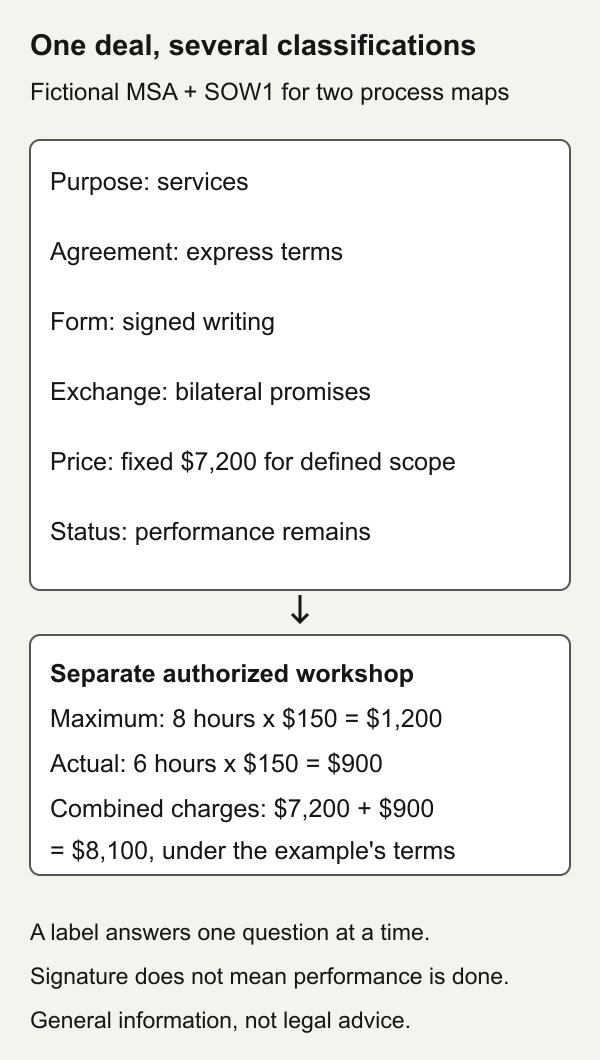
A separate hourly change does not reprice the original scope
On October 20, both parties sign change order CO1 for a workshop: $150 per authorized hour, up to eight hours, with no materials or additional expenses chargeable under this example. They specify the output, recording and approval requirements. The agreed maximum workshop charge is $1,200, but the fictional completed record shows six authorized hours, producing $900.
COMPLETED PRICING RECORD, FICTIONAL
SOW1: two maps, fixed price 7200 USD
CO1: workshop, 150 USD per authorized hour
CO1 maximum: 8 hours x 150 = 1200 USD
CO1 completed and authorized: 6 hours x 150 = 900 USD
Combined example charges: 7200 + 900 = 8100 USD
Maximum under these stated terms: 7200 + 1200 = 8400 USD
Unused ceiling: 2 hours / 300 USD, not an invoice item
Scope and approval evidence: retain SOW1 and CO1
The original two-map scope remains fixed-price under the example. The additional workshop is priced by authorized hours. The private arrangement's agreed ceiling and records control the arithmetic; this is not a demonstration of a FAR contract or a universal right to charge for unapproved extra work.
Executed and executory require a date and context
Deal administrators may use “executed agreement” to mean signed. For a performance record, state “fully performed” only after checking the relevant obligations. In the federal bankruptcy context, the Supreme Court described an executory contract as having performance remaining on both sides in Mission Product v. Tempnology. That context should not be replaced by an informal signature label. Mission Product, majority opinion, pages 1 to 3.
For Riverworks, the October 9 signatures do not mean delivery or payment happened. Delivery on October 26 leaves review. Acceptance on October 28 may leave payment. After invoice settlement, separately track continuing confidentiality, license, warranty and other duties. The executed versus executory contract ledger supplies dated status entries.
Termination, breach and invalidity are separate events. Mission Product held that bankruptcy rejection was a breach, not a rescission of the trademark rights at issue. It does not establish that every license survives every termination; the agreement and law remain relevant. Mission Product, majority opinion, pages 8 to 12.
Valid, void, voidable and unenforceable describe legal effect
Use these as review outcomes, not document-selection options. Valid means satisfying relevant requirements; void means the governing rule gives no legal effect; voidable means a qualifying party can avoid the arrangement; unenforceable means enforcement of an agreement or provision is barred. Exact consequences, remedies, timing and affected terms depend on law and facts. Statutes sometimes use overlapping labels.
- Void and unenforceable example: Washington RCW 59.18.230(1)(b) applies those words to specified landlord-tenant agreements arising from unlawful detainer proceedings that violate listed protections, subject to the stated exception. It does not make every lease void. RCW 59.18.230.
- Voidable example: For covered Washington commercial telephone solicitations, RCW 19.158.120(3) permits avoidance by written notice for specified violations or delivery failure. The statute separately rejects purported waivers of protected purchaser rights. It is not an unrestricted cancellation right for every business purchase. RCW 19.158.120.
- Enforcement barrier: The Washington goods statute can restrict recovery without a sufficient signed record, while preserving its listed exceptions. “Oral” alone does not settle enforceability. RCW 62A.2-201.
For formation, California CACI 302 addresses sufficiently clear terms, an exchange of value and agreement; its directions separately address disputed capacity and lawful purpose. Other jurisdictions and transactions require their own analysis. CACI 302. Identify the actual defect, who may raise it, deadlines, affirmation or waiver issues, severability and the available remedy.
The void versus voidable guide develops those distinctions. For undoing exchanged value, the contract rescission example separates a cash refund from discharge of an unpaid balance.
Adhesion, unconscionability and conditional risk are separate questions
A standard form offered with little negotiation raises questions about notice, assent, bargaining circumstances and disputed terms. Do not equate that process with acceptance by performance or diagnose invalidity from the heading. For Washington goods contracts, RCW 62A.2-302 permits refusal to enforce an unconscionable contract, enforcement without a disputed clause, or a limit on that clause. It provides for evidence of commercial setting, purpose and effect. RCW 62A.2-302.
“Aleatory” describes performance or value tied to an uncertain event, often discussed for insurance. Washington's insurance definition identifies an undertaking to indemnify or pay on specified contingencies. RCW 48.01.040. For selection purposes, identify the event, covered risk, exclusions and proof required. The label does not establish coverage or replace policy review. A contingent service incentive also needs defined conditions rather than a broad promise of “success.”
A checklist for choosing the right form
CONTRACT SELECTION CHECKLIST
[ ] State the business purpose and actual relationship.
[ ] Identify parties, authority, jurisdiction and regulated subject matter.
[ ] Record offer, terms, assent and the proposed acceptance method.
[ ] Separate agreement evidence from any restitution claim.
[ ] Identify return promises or requested performance.
[ ] Check writing and execution requirements.
[ ] Choose the agreement, orders, schedules and required addenda.
[ ] State which document authorizes work and which terms prevail.
[ ] Define scope, acceptance and change control.
[ ] Specify price, permitted costs, triggers and ceilings.
[ ] Allocate identified ownership, confidentiality and liability risks.
[ ] Check mandatory rights, defects, remedies and dispute procedure.
[ ] Compare the complete package for conflicts or gaps.
[ ] Save the final package and retrievable assent evidence.
[ ] Track performance, invoices, renewals and notices by date.
[ ] Record continuing duties and a closeout owner.
For Riverworks, the owner records “services” for routing, “bilateral” for exchange, “fixed-price plus approved hourly work” for finance, and dated delivery and payment tasks for operations. Keep the legal review outcome in its own field so a business tag does not become an unsupported enforceability conclusion.
Frequently asked questions
How many types of contracts are there?
There is no useful universal count across every classification. A list of business documents and a list of pricing methods answer different questions. Choose the dimension relevant to your decision.
Can a contract be both fixed-price and bilateral?
Yes. A buyer's promise to pay a fixed amount in exchange for a supplier's promise to deliver defined work describes both the price and the exchange.
Is an oral contract an implied contract?
Not necessarily. Spoken terms can be express. An implied-in-fact agreement is shown through conduct and circumstances. Specific writing requirements still need checking.
Is a signed contract fully executed?
Say whether you mean signed or fully performed. The signature, delivery, payment and continuing obligations can have different statuses.
Is quasi-contract an implied-in-fact agreement?
No. Keep agreement inferred from conduct separate from an obligation imposed by law without actual agreement. A restitution inquiry needs its own facts and legal basis.
Is a one-way NDA necessarily a unilateral contract?
The NDA label describes disclosure or confidentiality duties. Determine the exchange structure from what the offer requests in return.
Does fixed-price mean the price can never change?
Read the agreed scope, adjustments and change mechanism. In the fictional example, a separately signed hourly workshop adds $900 without repricing the original two-map scope.
Are there exactly three construction contract types?
Construction documents can be classified by scope, delivery structure, pricing and risk allocation. Do not transfer a simple fixed-price, reimbursement and hourly list into a universal construction rule. Review the actual project and specialist requirements.
What are the main types used in business?
Common document families include sales, services, confidentiality, licenses, leases, employment, collaboration and financing. Choose the form around the actual transaction and add the necessary schedules. A company does not need every document for every deal.
Does using a standard template make a contract enforceable?
No label or template establishes all necessary facts. Check the applicable formation, authority, lawful purpose, consideration and execution requirements, then review the completed terms and attachments.
Sources
- Judicial Council of California, CACI 2026, instructions 302, 304 and 305 on formation and evidence.
- Hercules, Inc. v. United States, 516 U.S. 417 (1996), pages 423 to 424 on implied agreement and federal jurisdiction.
- Southern Glass & Plastics v. Kemper, South Carolina Court of Appeals, No. 5021 (2012), court opinion reproduced by FindLaw.
- 15 U.S.C. 7001, official 2024 Code edition, electronic form, limits and consumer disclosures.
- Washington RCW 62A.2-201, goods-sale writing requirement and exceptions.
- Washington RCW 19.158.120, covered telephone purchases, avoidance and protected rights.
- Washington RCW 59.18.230, specified rental terms and agreements barred by statute.
- Washington RCW 62A.2-302, unconscionable goods contracts or clauses.
- Mission Product Holdings v. Tempnology (2019), majority opinion on executory contracts and bankruptcy rejection.
- FAR 16.101, federal categories.
- FAR 16.202-1, federal firm-fixed-price.
- FAR 16.301-1, federal cost reimbursement.
- FAR 16.601, federal time-and-materials.
- Washington RCW 48.01.040, insurance contingent obligations.
- UConn, Understanding Contract Types, its institutional procurement map.
Prepared with AI assistance. The business transactions, prices, dates and records are original fictional examples, not actual contracts, tests or legal findings. The banner is an AI-generated fictional illustration.