

Offer and Acceptance in Contract Law: Three Negotiation Examples
By Anirudh Menon, Viaclause editor
Trace offers, counteroffers and acceptance through three fictional email negotiations. Separate California service rules from goods and retain the right evidence.
Offer and acceptance describe how one party proposes a bargain and another assents to it. An offer invites agreement on identifiable terms; acceptance communicates agreement in the manner the offer and applicable law permit. The entire exchange matters, including conduct, conditions and the version being discussed. These concepts help identify agreement, but do not by themselves establish every requirement for an enforceable contract. Cornell Wex: offer; Cornell Wex: acceptance.
This guide uses California services examples and a separately labelled California goods example. It does not supply a universal US formation rule. Start with the types of contracts guide, and use the contract elements overview for capacity, consent, lawful purpose and consideration.
1. Identify the proposal before labelling the response
California's 2026 civil instructions distinguish a communicated, specific offer that reasonably invites a concluding acceptance from preliminary negotiation. Agreement is assessed through outward words and conduct, rather than hidden intention. The instructions are litigation guidance, not a substitute for transaction-specific advice. Judicial Council CACI 302 and 307.
A useful intake question is: What, exactly, could the recipient agree to now? A message asking for pricing and availability leaves different work to do than a defined proposal attaching a scope, price and acceptance process. Keep the attachment with the message. A forwarded sentence separated from its conditions can give the reviewer a misleading picture.
| Communication | What to examine | Evidence to retain |
|---|---|---|
| Request for a quote | Is it asking for a proposal or actually offering a defined bargain? | Full request, specifications and context |
| Detailed proposal | Terms, parties, conditions and proposed acceptance method | Exact version and all referenced documents |
| Reply expressing agreement | Unchanged assent, a condition or a new proposal? | Complete reply and delivery evidence |
| Work begins | What conduct was invited, known and actually performed? | Instructions, work records and communications |
| No reply | Prior dealings, shared understanding and any other conduct | Chronology without inventing an acceptance event |
Do not treat a friendly tone, a calendar invitation or an internal approval as a complete formation finding. Identify the actor and communication first. If a colleague is accepting for a company, review authority to sign on another's behalf.
2. Three versions of the same services negotiation
All names, messages, dates and prices below are fictional. Assume a lawful California business services transaction, capable parties, adequate consideration, authorised representatives, no special writing requirement, no prior dealings and no separate signed-master restriction. A real matter requires verification of those assumptions.
Juniper Analytics offers to clean one specified dataset for Harbor Studio. Proposal JA-03 identifies the input file, one cleaned output, a validation report and delivery on October 20, 2026. The price is $2,400, payable after the agreed deliverables. Its stated response process calls for an email accepting JA-03 without changes, received by the named business mailbox by October 8 at 17:00 California local time. The example does not rely on a general email or mailbox timing rule.
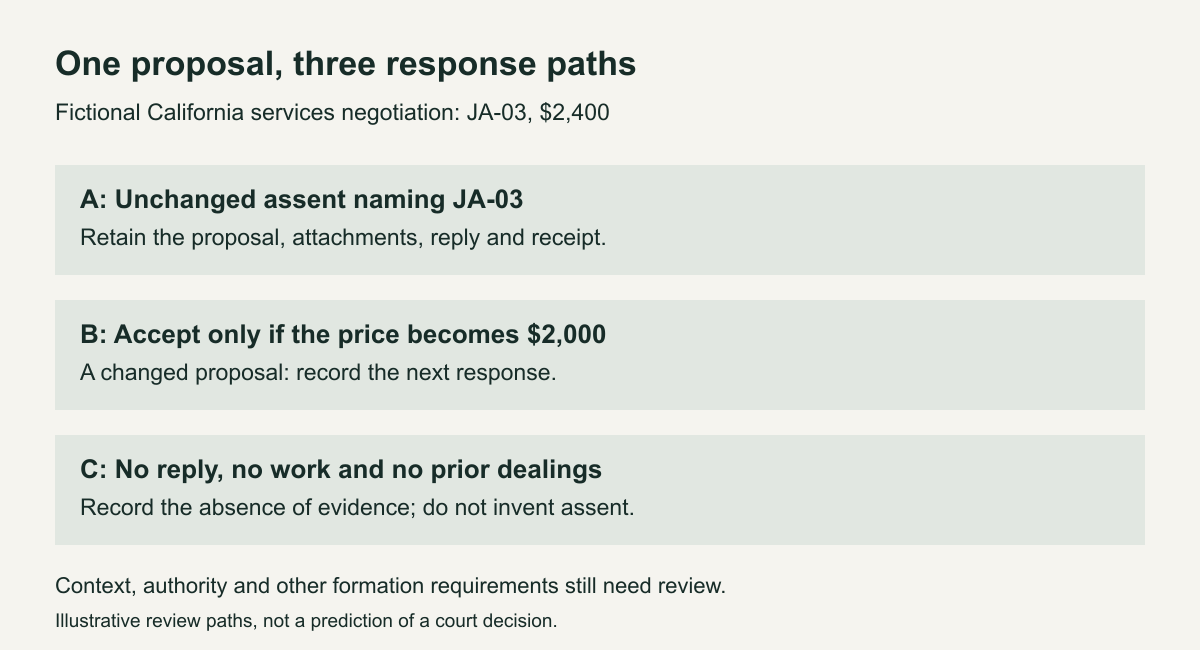
Version A: agreement on the identified proposal
October 6, 10:00: Juniper sends JA-03 and its attachments.
October 7, 11:00: Harbor replies:
Harbor accepts proposal JA-03, including its attached scope,
for $2,400 and delivery on October 20.
October 7, 11:02: Juniper's mailbox records receipt.
For the stated assumptions, this is the strongest record of unchanged, communicated assent. Preserve the proposal and attachments as received, the reply and the mailbox evidence. The two-minute transmission interval is part of the fictional record; it is not a legal tolerance. Do not later substitute JA-04 for the version mentioned in the reply.
Version B: the response changes the price
Harbor's reply instead says:
We accept only if the price is $2,000, with all other JA-03 terms unchanged.
Juniper does not answer and neither party starts work.
California Civil Code section 1585 treats a qualified acceptance as a new proposal. Here, the conditional wording calls for a further response; the worksheet should not mark unchanged acceptance of JA-03. The proposed reduction is $400, or one-sixth of the original price. If Juniper later agrees, retain that additional event and identify the resulting terms. California Civil Code: consent, including section 1585.
Compare that wording with a genuinely unconditional assent followed by a request to discuss a future discount. CACI 309's authorities distinguish a request or complaint from a response that changes the bargain. The entire message determines which description fits; the word “accept” alone does not settle it. CACI 309: acceptance.
Version C: no response and no work
Juniper writes a reminder:
If we hear nothing by October 8, we will assume you agree.
Harbor does not respond, receives no service and starts no work.
Under these assumptions, the reminder supplies no affirmative acceptance evidence. CACI 310 describes silence as ordinarily insufficient, with an exception where both parties understood silence or inaction as acceptance. Record “no response located,” rather than manufacturing an acceptance timestamp. The absence of prior dealings is a material assumption in this example. CACI 310: acceptance by silence.
3. Check the method, timing and conduct
California Civil Code section 1582 addresses prescribed communication conditions; section 1583 addresses transmission in conformity with those rules. Section 1584 recognises performance of a proposal's conditions as acceptance. Section 1587 includes lapse of the stated acceptance time. These provisions require assessment of the actual proposal and events. California consent provisions.
For JA-03, retain the named mailbox's records and the stated time zone. A sent-message screenshot without the attachment or destination leaves questions unanswered. If the proposal arrives on October 6 and the fictional acceptance arrives on October 7, do not describe it as an October 8 acceptance merely because that was the deadline.
If a different proposal expressly invites acceptance by completing a defined task, record the task, completion and knowledge of the performance. Starting preparatory work is not automatically the same event as completing a requested act. Use the unilateral contract guide for the distinct promise-for-performance issue, and the implied contract guide when conduct is central.
Where signatures or other formalities may be required, move that issue into a separate review field. The statute of frauds guide explains why an agreement event and sufficient written evidence are separate questions. Avoid collapsing formation, proof and enforceability into one checkbox.
4. Goods: a different response may still require contract analysis
California Commercial Code section 2207 permits a definite, timely acceptance despite additional or different terms unless expressly conditional on assent to them. Additional terms have their own merchant rules and exceptions. Conduct can establish a sale contract despite conflicting writings, with agreed terms and statutory supplements. Section 2201 separately addresses signed-record requirements for goods priced at $500 or more, subject to exceptions. California Commercial Code chapter 2.
Separate fictional goods example: Harbor orders 20 specified storage drives at $80 each, a $1,600 order. Juniper's timely acknowledgement agrees on quantity and price but adds a dispute clause. Do not simply reuse Version B's services conclusion. Counsel must examine the actual conditional wording, merchant status, objections, material alteration and signed records. The added dispute clause is an unresolved review item, not automatically part of the deal.
If the parties ship and receive the drives, preserve those events too. They answer a different evidence question from the wording in the forms. The statutory text does not justify a shortcut that whichever form was sent last wins. Nor does a formation analysis settle whether the drives conformed to the required specifications.
5. Copyable formation record, with a completed example
FORMATION REVIEW RECORD
Transaction and jurisdiction:
Parties and representative authority evidence:
Proposed terms and exact version:
Referenced attachments or master agreement:
Offer communicated by / to / at:
Required response method and conditions:
Response words or conduct:
Response sent / received / completed evidence:
Changes, objections or unresolved conditions:
Goods rules or special formalities to check:
Assessment, assumptions and reviewer:
Next action and retained source files:

COMPLETED FICTIONAL VERSION A
Transaction: California dataset-cleaning services.
Parties: Juniper Analytics and Harbor Studio; authority assumed.
Proposal: JA-03 with scope, $2,400 and October 20 delivery.
Offer: October 6, 10:00; full email and attachments retained.
Response: Unchanged acceptance naming JA-03 on October 7, 11:00.
Receipt: Named Juniper mailbox, October 7, 11:02.
Conditions: Receipt by October 8, 17:00 California local time.
Changes: None in the stated response.
Assessment: Assent documented under stated assumptions.
Open checks: Verify authority, all attachments and formalities.
Next action: Preserve records and confirm the operative terms.
Keep assessment changes visible. If a missing attachment is found later, record who found it and when, then revise the conclusion. Retain the earlier entry rather than overwriting the chronology. A helpful record can say “unresolved” while still identifying the next evidence request.
6. Formation review checklist
- Identify the transaction and applicable legal jurisdiction.
- Locate the full proposal and referenced documents.
- Separate negotiations from a proposal inviting concluding assent.
- Identify the recipient and representative authority.
- Read the entire response for changes and conditions.
- Check the actual method, timing and performance evidence.
- Separate services and goods analysis.
- Assess formalities and other formation requirements independently.
- Record assumptions, unresolved facts and retained evidence.
FAQs
What is the difference between an offer and acceptance?
The offer proposes the bargain; acceptance assents to it. Read the identified proposal and the response together. Wex: offer.
Does saying “I accept” settle the question?
No. In the completed examples, unchanged assent and “only if” wording have different review implications. Keep the entire message.
Is a counteroffer an acceptance?
California's services example treats the conditional price change as a new proposal. Goods require separate analysis; the two examples should not be merged.
Can silence be acceptance?
It ordinarily is not under CACI 310, but the parties' shared understanding matters. Do not extend the no-prior-dealings example to every relationship. CACI 310.
Can starting work accept an offer?
Conduct matters, but identify what the proposal actually invited and what occurred. Record preparation, requested performance and completion separately.
Does an email agreement always require a later signature?
That depends on the transaction, terms and applicable formalities. Preserve the exchange and identify any stated signature condition instead of assuming the answer.
This article is general information. Names, messages, arithmetic, graphic and worksheet are original illustrative aids. The banner is an AI-generated fictional illustration. No real negotiation, court result or professional legal review is claimed.
Sources
- Cornell Wex: offer, last reviewed August 2023, terminology.
- Cornell Wex: acceptance, last reviewed June 2022, terminology and communication.
- Official 2026 California civil jury instructions, CACI 302 and 307 through 311, including directions and authorities.
- California Civil Code consent chapter, sections 1582 through 1585 and 1587 relied on here.
- California Commercial Code formation chapter, sections 2201 and 2207 relied on here.