

When Does Breach of Contract Become Criminal?
By Anirudh Menon, Viaclause editor
Separate a missed promise from evidence of a crime, without treating a lost deposit as proof of fraud or satisfactory work as a complete defense.
A breach of contract is usually civil. It becomes criminal only if the conduct also meets a crime’s elements, such as fraud, theft by deception or knowingly issuing a bad check. A missed deadline or unpaid refund alone does not prove criminal intent. Identify what was represented, when, what money changed hands and evidence of knowledge or intent. New York’s false-promise law expressly rejects inferring intent from nonperformance alone.
Place this issue in context with the contract breach consequences guide before choosing a response.
Preserve original messages and payment records. For a time-sensitive suspected crime, IC3 directs people to local law enforcement rather than waiting for an online report.
What separates a contract dispute from a possible crime?
| Situation | What it establishes | What to check next |
|---|---|---|
| Genuine production failure prevents delivery. | Possible breach, not proof of fraud. | Terms, purchase records, explanation and refunds. |
| A seller knowingly invents allocated stock to obtain a deposit. | Possible fraud investigation. | Falsity, knowledge, payment and the offense’s other elements. |
| A seller never intended promised future delivery. | Possible false-promise theory. | Evidence beyond nonperformance and innocent explanations. |
| Useful work follows material deception securing the deal. | Performance does not necessarily defeat federal fraud. | Materiality, intent, money or property and interstate or foreign wires. |
| A buyer knowingly issues a check without sufficient funds. | Possible NY section 190.05 bad-check offense, a class B misdemeanor. | Knowledge when issued, intent or belief it would be refused, and refusal on presentment. |
Useful work does not necessarily rule out fraud; unfinished work does not prove it. For the separate civil issue, see when a breach also supports a tort claim.
Two cases that prevent opposite mistakes
Do not infer a scheme just from unfinished work
Unfinished work alone does not establish fraudulent intent. In People v. Churchill (N.Y. Court of Appeals, 1979), the court reversed the contractor’s conviction and dismissed the indictment. Purchased supplies, work started and customer-caused delays supported incompetence as an alternative explanation.
Under New York Penal Law section 155.05(2)(d), a false-promise theory requires more than nonperformance. Keep evidence of genuine purchasing and work alongside evidence supporting the complaint. Churchill illustrates its record, not a guaranteed defense.
Do not assume good work rules out fraud
Satisfactory work does not necessarily defeat federal fraud. In Kousisis v. United States (U.S. Supreme Court, 2025), contractors obtained public painting contracts through false disadvantaged-business representations. The Supreme Court affirmed: fraudulent inducement can support liability without an aim to cause net economic loss. Money or property must remain an object and deception must be material. The Court left the exact materiality test for a future case.
What makes an emailed promise a federal wire-fraud issue?
18 U.S.C. section 1343 covers a fraudulent money-or-property scheme executed through interstate or foreign wire communications. An emailed invoice alone is not enough: prosecutors must prove the offense’s elements.
Separate each payment request. A truthful original deal does not resolve whether a later request used intentional deception. An inaccurate update might instead be an error; preserve what the speaker could have known then.
Worked example: one missing order, three different evidence files
Hypothetical order: a buyer pays $4,000 on September 3 toward a $10,000 order due September 17. Nothing arrives; $1,000 is refunded September 22. The unreturned deposit is $3,000. The unpaid $6,000 balance is not the buyer’s paid loss.
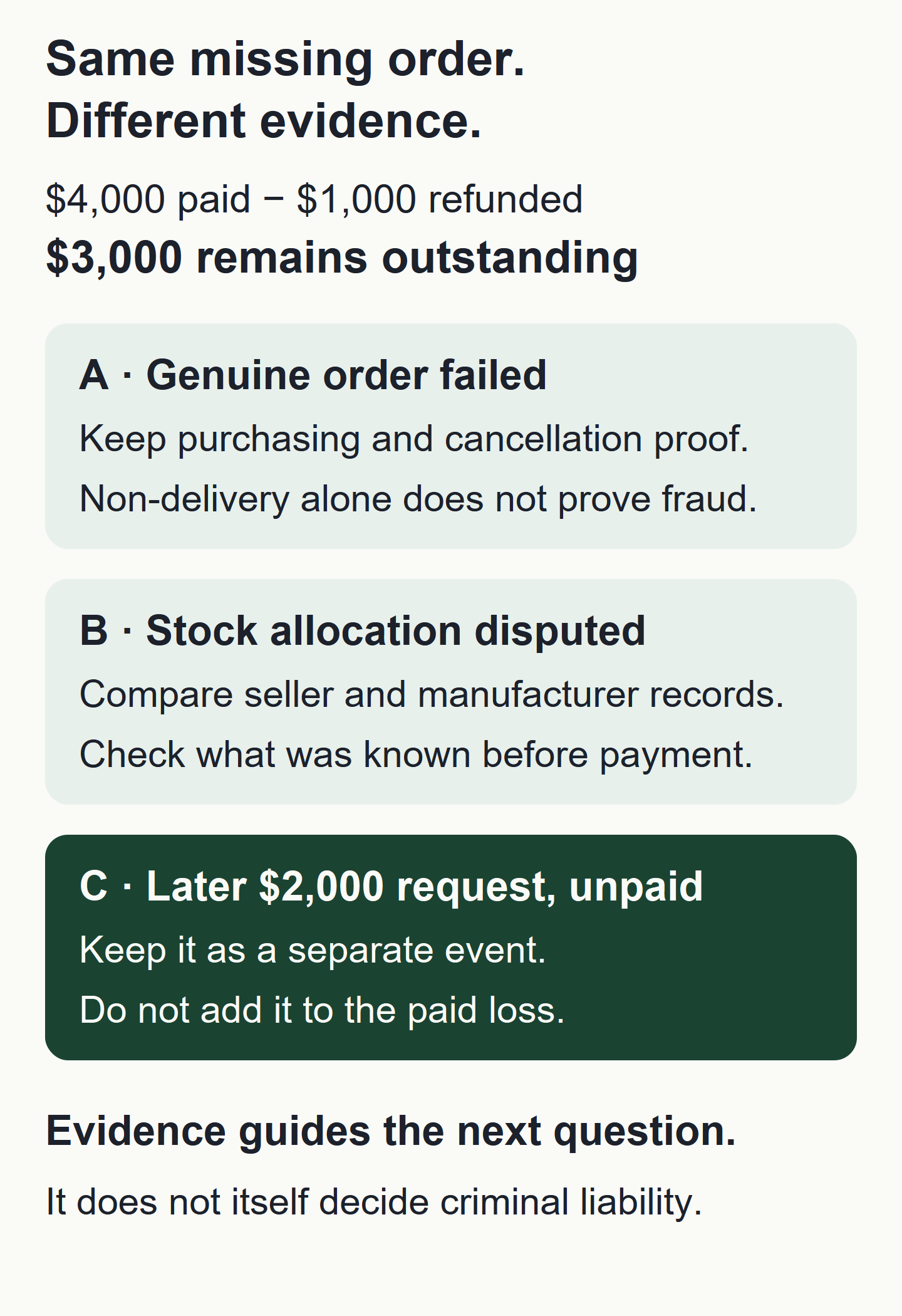
- A, failed procurement: A genuine September 4 manufacturer order, cancellation and replacement attempts support a business failure explanation. Preserve them with the refund claim.
- B, disputed stock: The manufacturer denies the seller's prepayment serial-number allocation claim. Verify sender identity, dates and what the seller knew.
- C, later request: After cancellation, the seller requests $2,000, claiming shipment. The buyer does not pay. Preserve shipment evidence separately; the request is not an additional paid loss.
The balance stays $3,000. Refunds do not settle earlier intent. Our actual damages worksheet covers the separate civil calculation.
Build a factual record before making an accusation
Record exact statements, dates, partial performance, refunds and both parties’ explanations. “The manufacturer denied allocating these serial numbers” is a documented statement; “the seller never intended to deliver” is an inference to investigate.
Agreement and delivery date: September 3 / September 17
Representation before payment: Seller said listed units were allocated
Original record: September 3 email, full thread retained
Payment: $4,000, September 3; bank confirmation retained
Performance observed: No delivery as of September 22
Contradictory evidence: Manufacturer message; identity still to verify
Supplier explanation: Record verbatim, with date
Refund: $1,000, September 22
Unreturned deposit: $3,000
Separate later request: $2,000, not paid
Inference needing investigation: Whether seller knew stock claim was false
Missing facts: Allocation history, sender authority, shipment records
Civil notice or filing deadline: Check separately
Report destination, date and reference: Not yet filed
Preserve originals and work from copies. IC3’s FAQ describes incident and transaction information and retaining original documents. Use our email evidence collection guide for preservation.
Where to take the record
For a contractual failure, follow the notice and dispute process and check civil deadlines. Report suspected crimes accurately. IC3 reviews cyber-enabled complaints and may refer them; it does not conduct investigations or guarantee prosecution or repayment.
Keep collection demands separate from criminal reporting. New York’s extortion provision includes obtaining property by instilling fear of a criminal accusation. If accused, preserve records and seek criminal-defense advice before substantive responses to investigators.
FAQ
Can you go to jail for breach of contract?
You cannot be jailed for a civil breach alone. Criminal liability requires a separate offense; disobeying a court order raises different issues.
Does taking a deposit and failing to deliver prove fraud?
No. The New York false-promise rule specifically rejects nonperformance alone as proof of the required intent. Record what happened before and after payment instead of treating the missing delivery as the entire case.
What if the supplier delivered something worth what I paid?
That does not automatically exclude federal fraud. Kousisis rejects a required aim of net economic loss in the fraudulent-inducement setting. The other requirements still matter, including material deception and money or property as an object of the scheme.
Does a civil fraud claim mean a crime occurred?
No. Cornell's fraud explanation distinguishes civil claims from statute-specific criminal offenses. A civil allegation or award is not itself a criminal conviction.
Will filing an IC3 report recover my deposit?
It is a reporting route, not a promised recovery service. Keep your civil deadline review moving separately and retain the report confirmation with your evidence.
Can I report it to the police?
Yes. You can report to local police or the district attorney. They may treat a pure non-delivery as civil, so bring the dated record above. The IC3 guidance also directs time-sensitive reports to local law enforcement.
What does each route produce?
Civil: you sue for damages or a refund, generally proving your claim by a preponderance of the evidence. Criminal: a prosecutor decides whether to charge, proof must be beyond a reasonable doubt, and possible outcomes include fines, imprisonment or restitution. Section 1343 generally permits up to 20 years, with a 30-year maximum for specified disaster-related or financial-institution cases. Neither route replaces the other; keep the civil deadline separate.
Sources
- New York Penal Law section 155.05: larceny, false promise and extortion.
- People v. Churchill, 47 N.Y.2d 151 (1979): Court of Appeals decision; CourtListener citation link.
- Kousisis v. United States (U.S. Supreme Court, 2025): Supreme Court majority opinion.
- 18 U.S.C. section 1343: federal wire-fraud statute.
- FBI Internet Crime Complaint Center FAQ: reporting, retention and agency-role guidance.
- Cornell LII Wex: fraud: civil and criminal distinctions.
- New York Penal Law section 190.05: elements and classification of issuing a bad check.
- U.S. District Court, District of Massachusetts glossary: civil and criminal burdens of proof.
- Eastern District of Tennessee: Understanding Your Case: criminal procedure, proof and sentencing outcomes.
- Cornell LII reproduction of section 1343: statutory text and sentencing exception.