

Conformed Signature: Meaning, /s/ Format and a Worked Filing Example
By Anirudh Menon, Viaclause editor
Understand a conformed signature, distinguish /s/ notation from proof of signing, and use a worked Maryland court example, record worksheet and checklist.
A conformed signature is a typed representation of a signature in a document copy, commonly shown as /s/ Asha Morgan. In a court filing, that notation can stand in for the visible handwritten signature when the applicable filing instructions permit it. The typed name tells the reader how the copy represents signing; it does not, by itself, prove who signed, establish authority or satisfy every recipient’s requirements.
The practical question is: what signing event and retained record support this particular copy? This guide uses a specific United States District Court for the District of Maryland example. It is not a nationwide filing rule or a substitute for the receiving court’s current instructions.
This article is general information. The people, document identifiers and workflow below are fictional. The banner is an AI-generated illustration.
What does /s/ mean beside a name?
The notation commonly signals that the document is presenting a signature in typed form. For example, a filing copy might display:
/s/ Asha Morgan
Asha Morgan
Do not treat these characters as a universal signature service. A recipient may require a particular format, an attachment, a certification, the filer’s authorization or a different signing method. First identify the destination and document type, then check its requirements. The Maryland court’s non-attorney signature instructions, discussed below, illustrate why the supporting record matters.
A signature question is also different from the broader question of whether an agreement exists. Our contract-elements guide explains the formation inquiry; a neat signature block cannot answer every issue about consent, terms or consideration.
Conformed, wet, electronic and digital signatures compared
| What you see | What to investigate | What not to assume |
|---|---|---|
| Conformed signature: a typed representation such as /s/ plus a name. | Which original signing event, permission and destination-specific procedure support the copy? | The notation alone establishes authorization or acceptance everywhere. |
| Wet signature: handwriting made with ink on the original paper. | Who signed which complete version, and where is that record? | An image of one signature page proves the contents of every associated file. |
| Electronic signature: a sound, symbol or process linked to a record and adopted with signing intent. | How is the act connected to the signer and the exact record? | Every typed name in correspondence was intended to execute an agreement. |
| Digital signature: a cryptographic signature mechanism. | What validation information establishes authenticity and integrity for this file? | A visible /s/ mark provides cryptographic verification. |
The electronic-signature description follows 15 U.S.C. 7006(5), including its intent and record-association requirements. NIST’s digital-signature glossary describes the cryptographic mechanism, including authenticity and integrity when properly implemented. These describe different questions; a document can have a visible signature representation without having a digital signature.
For paper originals, scans and business signing decisions, see what a wet signature is. Keep the method, the supporting evidence and the receiving party’s requirements separate in your review.
A court-specific example: Maryland federal filings
The District of Maryland’s published guidance for documents signed by people who are not counsel of record permits three electronic submission routes while requiring counsel to have and maintain a signed copy: scan the hand-signed document; use /s/ with counsel’s signed-copy statement; or use /s/ with a scanned signature-page attachment. Check the current instructions and any applicable order before choosing a route.
Attorney signatures have separate Maryland instructions. Those address filings through an attorney’s credentials, multiple-attorney signatures, permissions and records. One multiple-attorney option requires permission and a record of when and how it was obtained. Other options specify signed-copy retention through exhausted appeals or expiration of appeal time. Do not transfer those conditions to every document or every court.
Nor does the federal E-SIGN Act provide a shortcut for official court papers. 15 U.S.C. 7003(b)(1) excludes court orders, notices and official court documents required to be executed in court proceedings from section 7001’s provisions. This is an exception to those provisions, not a nationwide prohibition on electronic court filing.
Worked example: three records, one document version
Assume counsel has checked the applicable Maryland instructions and selected the signature-page attachment route for a document signed by a person who is not counsel of record. This is a fictional preparation exercise, not a filing or a complete court-ready declaration.
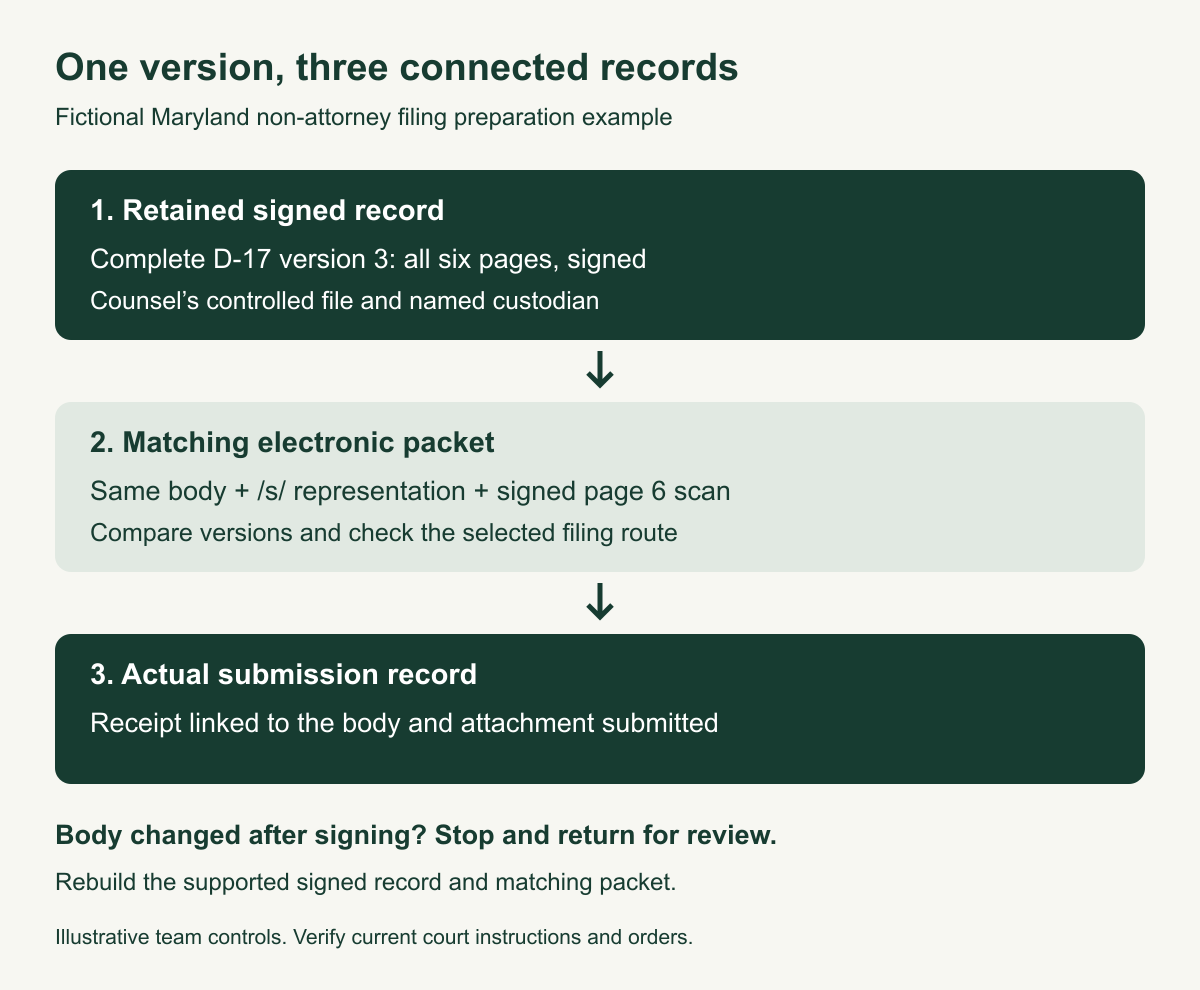
Asha Morgan reviews and signs Declaration D-17, version 3, a six-page document. The legal operations coordinator receives the complete signed copy and places it in counsel’s controlled file. The filing preparer creates an electronic representation of that same version and a readable scan of its signed page 6. No factual statement is changed between the signed version and the representation.
The team’s preparation packet contains:
- Retained record: all six pages of signed D-17 version 3, with counsel’s file location and custodian recorded.
- Filing material: the corresponding electronic document displaying /s/, plus the scan of its signature page for attachment.
- Reconciliation record: a version check identifying which body and attachment were submitted, followed by the actual filing receipt when available.
Signature representation for this example
The following illustrates the notation and attachment statement for the selected route. The footnote reproduces the court’s wording; the name is fictional. It is only a signature-block example, not the substantive declaration or permission to file it.
/s/*
Asha Morgan

*A copy of the signature page bearing an original signature is attached hereto.
The attachment statement comes from the court’s Option 3 example. Use it only when the stated attachment is present and the applicable procedure is satisfied.
Completed record worksheet
This worksheet is original and copyable. Replace its fictional details with verified facts; an unresolved field is a task to complete, not evidence that the step occurred.
Document: Declaration D-17
Signed version: 3, six pages
Signer: Asha Morgan
Role: person who is not counsel of record
Destination: United States District Court, District of Maryland
Selected route: electronic document with scanned signature-page attachment
Complete signed copy: received by counsel and stored in matter file D-17/v3/signed
Custodian: filing counsel, designated matter file
Electronic representation: D-17-v3-filing.pdf
Signature-page scan: D-17-v3-page6-signed.pdf
Version comparison: body compared with complete signed version 3; no content change identified
Attachment check: page 6 scan readable and associated with version 3
Court instructions: checked for this document and proceeding
Other filing requirements: counsel to confirm event, redactions and applicable orders
Submission status: prepared; not yet filed
Receipt: pending actual submission
Retention review: counsel to record applicable requirements and any preservation hold
The worksheet deliberately says “not yet filed.” A folder full of prepared PDFs is not a submission receipt. After an authorized filing, reconcile the receipt with the actual documents submitted rather than marking the packet complete from a calendar reminder.
The version-change failure
Suppose someone corrects a material factual assertion in paragraph 8 after Asha signs version 3, producing version 4. Copying the same signature page and /s/ notation into that new packet would conceal the change from the team’s review record.
In this workflow, stop the packet. Return the changed document to counsel for review, obtain an appropriately signed revised record before using the selected route, and rebuild the matching electronic document and attachment. Mark version 3 as superseded for the proposed filing without destroying the retained record. The team must not write “no content change” in the worksheet when the body changed.
For related record handling, our email-evidence packet explains how to preserve surrounding communications rather than collecting isolated screenshots. Those communications can help reconstruct who approved a version and what was transmitted; they do not replace document-specific signing requirements.
Can a business use /s/ in a contract?
A court’s filing example does not decide how a private contract should be executed. For a California transaction, Civil Code 1633.5 conditions the electronic-transactions title’s application on the parties’ agreement to transact electronically, assessed from context and conduct. Civil Code 1633.9 addresses attribution to the person whose act it was and the significance of surrounding circumstances. Neither inquiry is answered just by typing /s/.
Before accepting a typed signature representation in a business packet, ask:
- Which jurisdiction, document category and execution requirements apply?
- What did the purported signer actually do or authorize for this exact version?
- What shows signing intent and the person’s capacity to act for a company?
- What process did the parties agree to use, and did the recipient accept this form?
- Where are the complete signed record, approval communications and relevant audit evidence?
Take unresolved execution issues to qualified counsel with the complete packet. Our lawyer-review preparation guide helps frame the decision and missing information. Avoid turning an unexplained signature block into an unsupported “fully executed” label.
Conformed-signature checklist
- Destination: identify the court, agency or private recipient and document category.
- Current procedure: verify the receiving body’s instructions and relevant orders.
- Signer: distinguish counsel of record, another attorney and a non-attorney signer.
- Supporting act: confirm the signing event or permission required for the chosen route.
- Exact version: compare the represented body with the supported signed record.
- Packet: check attachments and statements against what is actually included.
- Custody: identify the responsible person and a retrievable location for the full record.
- Receipt: record actual submission separately from preparation.
- Retention: check applicable rules, orders, policies and preservation requirements; do not invent a universal period.
A contract repository should connect the record with its attachments and history. In contract lifecycle management, separate internal approval, execution and activation so a prepared or approved document is not mistaken for a completed signing event.
Frequently asked questions
Does /s/ mean the document was signed by hand?
Do not infer the underlying method from the mark alone. Ask what record supports it and which procedure permitted its use. The chosen route in the worked example starts with a signed copy and uses a signature-page attachment; another destination may have different requirements.
Can I type someone else’s name after /s/?
Typing is technically easy; permission and procedural compliance are separate. Confirm the required authority and supporting records before representing another person’s signature. Do not treat possession of a name or an old signature image as approval for a new document.
Is a conformed signature a digital signature?
A typed representation alone is not a cryptographic signature. If digital verification matters, obtain and validate the relevant file and verification information rather than judging the visible signature block.
Should I keep just the scanned signature page?
Keep the supported complete document and its connection to the representation. A detached page does not tell a reviewer which body was signed. Follow the actual retention requirements; the example worksheet intentionally contains no universal number of years.
Does E-SIGN make every court accept /s/?
No. The court-document exception described above means section 7001 cannot serve as that blanket acceptance rule. Consult the particular court’s current filing instructions.
Is a conformed copy the same as a certified copy?
Do not assume a typed signature representation supplies an issuing authority’s certification. If someone requests a certified copy, ask exactly what certification and issuing process they require. A filename reading “certified” is not evidence of that process.
Sources
- United States District Court, District of Maryland: non-attorney signature formats
- United States District Court, District of Maryland: attorney signature formats
- 15 U.S.C. 7003: exceptions to E-SIGN provisions
- 15 U.S.C. 7006: electronic-signature definition
- California Civil Code 1633.5: agreement to electronic transactions
- California Civil Code 1633.9: attribution and context
- NIST CSRC glossary: digital signature